

Anti-Hazing Resources & Transparency Report
UNCG STATEMENT ON HAZING
The University of North Carolina at Greensboro does not support any forms of hazing. Community members are encouraged utilize the Concerning Behavior Form if they are concerned about potential hazing incidents. The campus hazing transparency report, including a five-year history of organizations found responsible for violating the Code of Conduct (hazing) is provided here. Hazing statistics are also included in the Annual Security Report.
what is hazing?
Any action taken or situation created, intentionally or unintentionally, whether on or off University premises, to produce mental or physical discomfort, embarrassment, harassment, or ridicule is considered hazing, regardless of the willingness of the participant. Such activities may include but are not limited to the following: use of alcohol; paddling in any form; creation of excessive fatigue; physical and psychological shocks, road trips or any other such activities conducted on or off campus; wearing of public apparel which is conspicuous and not normally in good taste; engaging in public stunts and buffoonery; morally degrading or humiliating games and activities; and any other activities which are not consistent with academic achievement, the five University values (honesty, trust, fairness, respect, and responsibility), or the regulations and policies of the University or applicable state law.
Definition adopted from the FIPG Risk Management Manual (2003).
why does it matter?
Individual schools, organizations, state and local laws vary. However, the consequences for hazing can be severe. Individuals involved with hazing may be suspended for a period of time or expelled, and/or face additional sanctions which may include referring the case to law enforcement.
Student groups/organizations or athletic teams involved with hazing may be sanctioned by withholding of college/university funds; suspension of the club status or charter; disqualifying it for funds, space or activities; forfeiture of games/meets or agents; suspension from meeting or playing for the duration of the season; or disqualification from recognition and awards.
Laws and Policies
- UNCG Anti Hazing Policy and Student Code of Conduct Section 5:6
- North Carolina State Hazing Law
- Stop Campus Hazing Act (S.2901, H.R. 5646)
hazing incident transparency report
Read the full 2025 Campus Hazing Transparency Report
How do I interpret the report
Understanding an institution’s hazing incident transparency report can be challenging. Campuses vary in the ways they compile reports and the language they use. Campuses typically only disclose hazing incidents that are investigated, and it was determined that the policy was violated. It is important to keep in mind that many hazing incidents are not reported. This can be due to a variety of factors, including fear of repercussions, a lack of understanding of what constitutes hazing, or simply not recognizing the behaviors as hazing. Furthermore, conducting hazing investigations can be challenging. Many students who experience hazing are reluctant to share firsthand accounts, making it difficult to demonstrate a “preponderance of the evidence.” To support your interpretation of an institution’s transparency report, see the list of questions to ask yourself as you review the reports.
- Prevention Toolkits & Guides
- Hazing Prevention Framework (HPF) – the only data-driven framework for hazing prevention
- Spectrum of Hazing
- Hazing Incident Transparency Reports
- Digital Tools & Downloads
- Webinars
- Policy & Laws
how to report incidences of hazing
Here at UNCG, and nationally, we know that student involvement in a variety of experiences promotes student success. However, when hazing is part of that experience students can find themselves struggling with activities that compete with academics, with feelings of isolation, suffering from sleep deprivation, or subjected to abuse.
We encourage all UNCG community members to stand up to hazing. If you see something, say something: to your coach, your advisor, a faculty member, or administrator. You can also file Concerning Behavior Form with the Office of Student Rights and Responsibilities. If someone’s life is in danger call UNCG PD 336.334.4444 or call 911 immediately.
anti-Hazing resources
Hazing is more prevalent than you know and can be subtle or overt. Many assume that hazing is relegated to fraternities and sororities, but that assumption is grossly inaccurate. Hazing occurs in all groups, like pre-professional organizations, sports teams, music groups, and other clubs.
According to national statistics from insidehazing.com, hazingprevention.org, and hazingstudy.org…
- More than half of college students are involved in some form of campus hazing².
- In 95% of hazing cases, students who were aware they were hazed did not report it².
- In 25% of hazing cases, coaches or advisors who were aware of hazing incidents did not report it².
- For every 10 students being hazed, only one of them realizes that they have been hazed².
- In more than half of the hazing incidents, a member of the offending group posts pictures on a public web space.
- Students are more likely to be hazed if they knew an adult who was hazed¹.
- At present in the United States, 44 states have anti-hazing laws².
- Since 1970, there has been at least one hazing-related death on a college campus each year².
- 82% percent of deaths from hazing involve alcohol².
- The first recorded incident of hazing involving sexual abuse occurred in 1983. Other hazing incidents involving sexual intimidation, nudity or stimulation, have been increasing in their frequency since 1995².
Where Does Hazing Take Place?
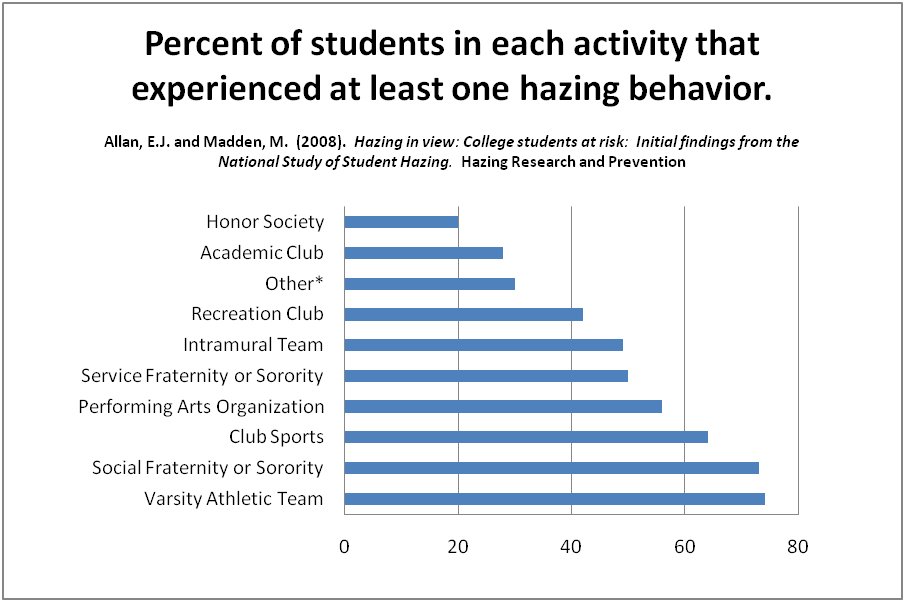
References for above statistics:
- Alfred University Study, Dr. Norm Pollard, Dr. Elizabeth Allan et al, 1999
- National Study of Student Hazing, Hazing in View: Students at Risk, Dr. Elizabeth Allan and Dr. Mary Madden, 2006 – 2008
- Dissertation, Dr. Colleen McGlone, 2005
- Insidehazing, Dr. Susan Lipkins, 2006
Research
Infographics from Hazing in View: College Students at Risk
University of Maine Study – Hazing in View: College Students at Risk
Langford & Associates – Comprehensive Approach to Hazing Prevention